
Transforming K12 by focusing on the Context
Schools rank kids on standardized tests using a conveyor belt model. We tolerate failure for the bottom percentage.

If you hear someone say out loud “School Success,” what comes to your mind? Maybe a picture of a hustling and bustling school corridor where a bunch of students are walking around in neatly tucked school uniforms? Or a school lobby where an authoritative adult is walking with pride, peeking into the classrooms, looking like they have figured it all out?
For the last 100+ years, our idea of school success has been, very narrowly, based on academic outcomes. The institution that is supposed to “educate” the future generation measures their success based on a small set of factors primarily focused on verifying skills required to do well in standardized tests. We rinse and repeat this whole process for the 12 most important years of a young person's life—thanks to the century-old, conveyor-belt-inspired model of producing job candidates. (pic 1).
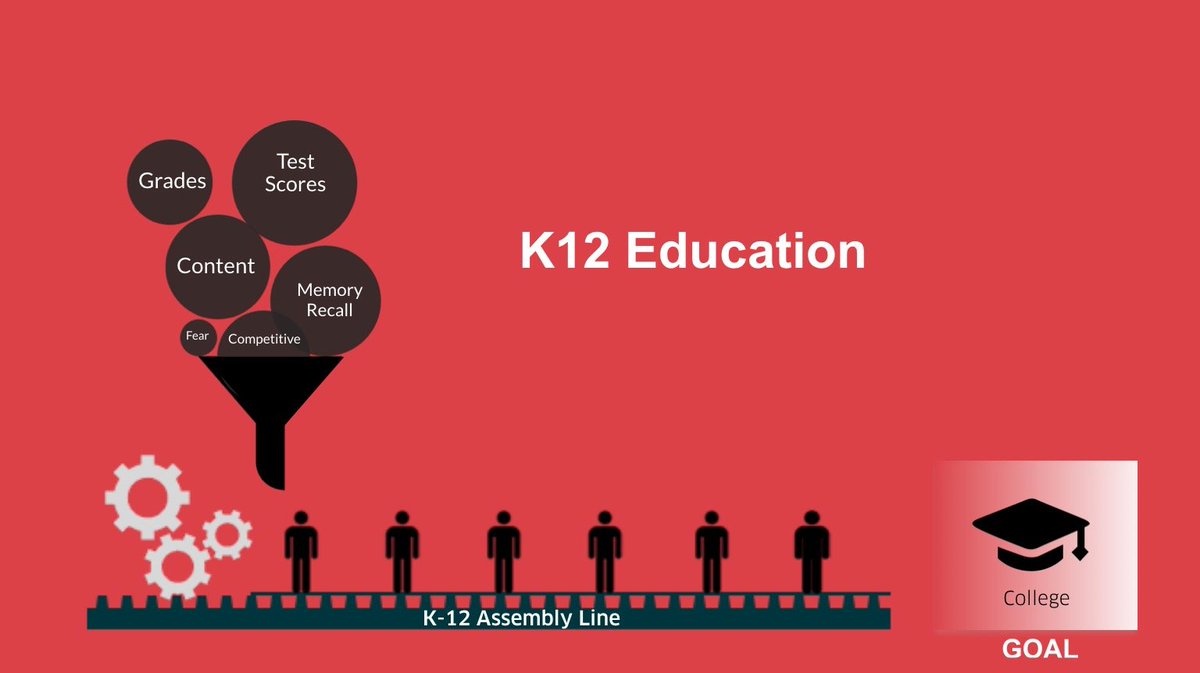
We also tend to measure school and student success in relative terms. One school is always better than the other; one student has higher performance than another. The measurement is designed to rank and file—so that someone looking at the results can easily distinguish “good” from “bad.” Applying this process further, a school that has a higher percentage of students achieving high points on standardized tests (Math & ELA) is considered more successful.
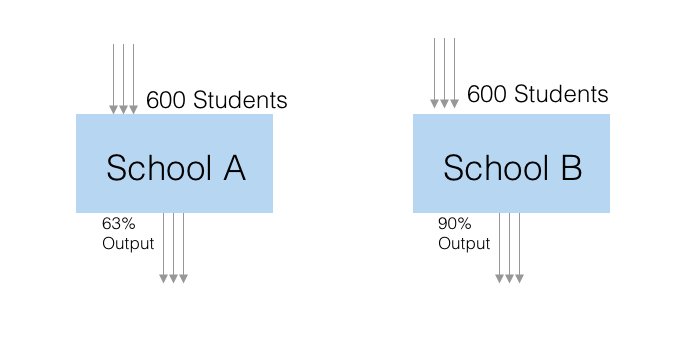
In the traditional view, it is clear that School B is more successful. But a closer look reveals a few additional questions. First, what did the success output include? Most probably it was in terms of academic ability, which is defined as proficiency in Math & ELA. Second, why was it okay to settle for less than 100% results? What about the remaining 37% and 10%? Where did the tolerance for anything less than perfection come from, and when did it become a norm? Without realizing it, we started the process of dividing our kids into "good" and "bad."
The Aviation Paradox
If we apply this same process to the airline industry, the results are terrifying. Simple math shows that we would lose 60 aircraft in the best-case scenario every single day. You wouldn’t accept that, would you? You wouldn't board a plane if the airline boasted a "90% success rate" for landings. (Pic 3)
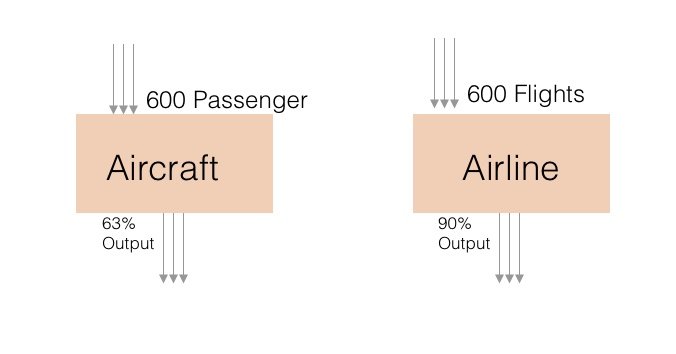
How we got here? The answer lies in what we choose to measure. For aviation, the failure rate was incredibly high at its inception. But we became good at measuring and improving what was meaningful. As technology advanced, onboard sensors allowed us to track every variable in real-time. Today, air travel is one of the safest ways to travel because the metrics are tied to survival and precision.
While there is hardly a one-to-one comparison between the airline industry and education, the core truth remains:
if we fail to measure the right things, we will land up making the wrong things better.
That is exactly what has happened to education. We have become incredibly efficient at a model that is increasingly irrelevant.
Right measurement is everything.
What you measure gets managed. In primary schools worldwide, our measurement criteria continue to be driven by a narrow notion of academic ability. As the late Sir Ken Robinson noted, if we create such a narrow idea of ability, the idea of "disability" gets magnified. While preparing students for a high-paying job is not a problem in itself, it becomes a disaster when it serves as the absolute ceiling of education.
The final goal of education as a mere means to get to college wasn’t acceptable to us. We came up with a revised mission at Schoolze:
“To help each child realize his or her maximum potential, make them fearless & provide with internal & external tools that help them in leading a happy and fulfilling life in a fast changing world!”
The Seven Factors of Context
In my years of operating Schoolze, I’ve realized that we have been ignoring the "Context" in favor of the "Content." If we want to achieve that mission, we have to track the parameters that actually determine a student’s ability to navigate life. We have identified seven factors that, if measured and enhanced, will show an upward trajectory in every foreseeable metric:
Engagement: Not just attendance, but active, emotional participation.
Fun-factor: Learning is most effective when it is driven by joy and curiosity rather than fear of a grade.
Empathy: The ability to understand others is a core 21st-century survival skill.
Mindfulness: Providing students with breathwork and clarity of thinking tools.
Growth-mindset: Teaching students that intelligence is a muscle, not a fixed number.
Focus: In a world of infinite digital distraction, the ability to sustain attention is the ultimate competitive advantage.
Compartmentalization: The ability to manage stress by separating different areas of life.
Individually, these parameters are proven to improve student experience. Together, they are magical.
The Tech-Driven Solution
Why haven't we measured these before? Because it was hard. It’s easy to grade a multiple-choice math test; it’s hard to quantify "empathy" or "focus" in a room of 30 children. But we are no longer in the 20th century.
At Schoolze, we are on a mission to create technology tools that measure these success outcomes. We are building a platform that uses Artificial Empathy and S.T.P. (Student-Teacher-Parent) frameworks to triangulate how a student is actually growing. We can move away from the high-stakes "snapshot" of a final exam and toward a continuous "movie" of a student's development.
This website is my attempt to bring awareness to what is now possible. What was impossible 100 years ago is now within our grasp. But the technology is only half the battle. The other half is the courage to stop valuing what we measure and start measuring what we value.
If we keep trying to make the "conveyor belt" faster, we will just produce more stressed-out graduates for a world that doesn't need them. But if we focus on the Context, we can build a new system entirely.
Stay tuned as I dive deep into each of these seven factors in the coming weeks. The journey to 2019 was about building tools; the journey beyond is about building context.
In last three years of operating Schoolze and learning about school success, we have come up with seven factors, that, if measured and enhanced, schools will start showing an upward trajectory in any foreseeable metrics. Individually all these parameters are proven to improve the student experience and increase achievement, but together they are magical. Here are these seven factors.
Engagement
Fun-factor
Empathy
Mindfulness
Growth-mindset
Focus
Compartmentalization
At Schoolze, we are on a mission to create technology tools to measure and enhance success outcomes for schools and students. This website is my attempt to bring awareness that what was not possible 100 years ago in education, is now possible and as AGI and Artificial Empathy technology becoming mainstream, future is bright. Through the course of 2019, I will use this website to write in detail about each of these factors and also reveal how we measure it. If you have any questions or comments about our work, please reach out at avneesh@schoolze.com. Stay tuned!
About the Author
Avneesh is the founder of Permissionless Academy, a platform for young adults to build leverage using AI.
He spent a decade inside the K-12 system building Schoolze (now Schoolze Labs) before concluding that meaningful education reforms have to come from outside it. Today he runs six AI-native and legacy products solo, with agents at the core and no traditional team!
He writes about education, agency, and building leverage in the age of AI!
Related Posts
Successful People
"Successful people create companies. More successful people create countries. The most successful people create religions."
Twitter Widget Iframe
A lot of people ask me what the ideal cofounder looks like. I now have an answer: Greg Brockman.
Aliens
I don't believe that any of the blurry UFO photos are real, for a very simple reason--they all resemble a slightly more advanced version of the the then-current technology and style. It seem very unlikely a spacecraft would fit the gestalt of the decade during which it crashed into earth.